ONE EXPLORER
How to play solo
Keep a table of inputs, observations and rejected models. Work between the three benches at your own pace. A notebook and calculator are useful; the manuals explain the rules you need.
Start on your own →THE EXAMINER’S CABINET
An optional expert challenge for curious minds.
A brass research cabinet has been dismantled before its settings were recorded. Discover its hidden rules, rebuild a workable schedule and leave a proof the next keeper can reproduce.
Free beta · Solo or cooperative play · No download
FROM THE GAME · NO COMPLETED ANSWERS
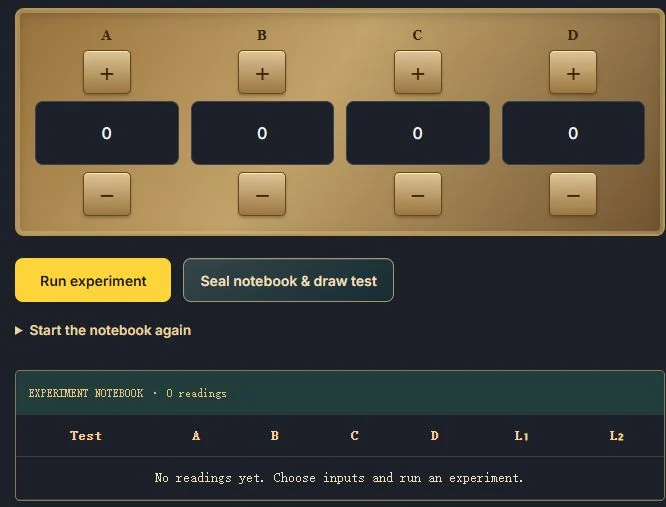
The wiring bench offers competing models for the same apparatus. Choose switch settings, observe the lamps and discard models that disagree. Separate benches ask you to infer an instrument rule and schedule work on shared equipment.
Captured from the playable interface in a local test. Room conditions may differ. The screenshot is not a walkthrough.
Try a short practice puzzleONE EXPLORER
Keep a table of inputs, observations and rejected models. Work between the three benches at your own pace. A notebook and calculator are useful; the manuals explain the rules you need.
Start on your own →TWO EXPLORERS
Let one person design an experiment while the other predicts what each candidate would do. Compare predictions before running the test, then exchange roles. Check the restoration schedule together before sealing it.
Open a room for two →A SEPARATE PRACTICE PUZZLE · NO ROOM NEEDED
A training lamp could follow either OR (on when at least one switch is on) or XOR (on when exactly one switch is on). A test with A on and B off lights the lamp. Which switch setting should you test next to distinguish the models?
Choose a test where the candidates disagree. This two-switch exercise is a simplified practice example; your game uses its own models, observations and validation inputs.
EXPERIMENT · DEDUCE · COORDINATE
These puzzles ask you to build a method, test it and use it again. The three benches can be investigated in any order. Their results come together in a final challenge.
Choose inputs for an unfamiliar brass instrument and record what its registers show. Infer the relationship, seal your experiment log and predict the results of fresh inputs.
Several wiring diagrams could explain the lamps. Choose switch combinations that separate those explanations, eliminate the wrong models and test your surviving theory.
Three work orders share limited benches. Preserve each operation’s sequence, avoid resource clashes and find a schedule that meets the deadline.
A COLLEGE GAME NIGHT WITH A CHALLENGE
Bring a university society, a few classmates or friends who enjoy explaining why a solution works. Divide the benches between players, compare experiment notes and check each other’s assumptions before committing a result.
It also works as a solo investigation. Paper, a calculator and careful notes are useful. The manuals introduce the rules, including wraparound arithmetic and Boolean logic; the challenge is deciding how to use them.
WHAT MAKES IT HARD?
New rooms receive different hidden settings. Sealing an experiment log reveals fresh test inputs, so a memorized code does not settle the investigation. The final proof links your restoration schedule to the instrument and wiring rules.
“Undergraduate-style reasoning” describes the design target. Difficulty has not been calibrated against a university course or formal assessment. No degree or minimum IQ is required.
Choose Expert Challenge, enter a nickname and share the invitation code. There is no email signup or payment during the beta.
Explore the three parallel benches together or divide them between teammates. Use your own voice call if you are playing apart; room progress and notes are shared.
Bring your results together for the final proof. Optional hints explain useful methods. There is no speed score; the room remains available for three hours from creation.
For a college puzzle club or a group of friends, the hosting guide helps you organize the conversation while the research benches run in parallel.
If you are looking for “high-IQ games” because you enjoy difficult reasoning puzzles, this challenge offers experiments, deduction and planning. It does not measure IQ, award an intelligence score or claim to improve intelligence.
The Examiner’s Cabinet concentrates on connected logic experiments and planning. Our story escape rooms put more emphasis on characters, observation and combining narrative clues. Choose the expert route when your group wants a more analytical game night.
You need patience with numbers, rules and written instructions. The manuals explain the puzzle conventions. Experience with algebra, logic or scheduling can help, but enrollment in college and specialist subject knowledge are not entry requirements.
The game runs in a browser and friends can join the same room from their own devices. A larger screen is helpful for comparing experiment tables and schedules. The suggested group is 1–6; a shared room supports up to 10 members.
AI may help with reasoning, and we cannot guarantee that it cannot solve the challenge. Changing conditions and fresh experiments reduce the usefulness of a copied answer. For a self-directed challenge, your group can agree to use its own notes, a calculator and the in-game hints.
Yes, it is free during the beta, like the three story missions. Patreon support is optional and is not required to create or join a room.
OPEN THE CABINET
Investigate missing evidence in Museum After Dark, share clues across a century in Signal Across Time, or guide a ship through a storm in The Last Lighthouse.